The Man I Rescued in a Storm 20 Years Ago Knocked on My Door Yesterday!
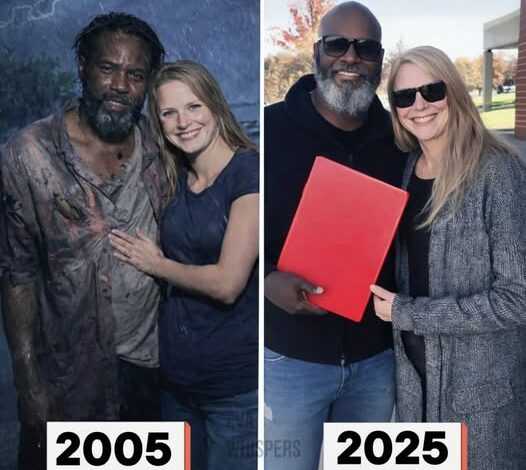
The sky over the small coastal town was a bruised purple, heavy with the promise of a deluge that would eventually wash away the remaining heat of summer. Twenty years ago, on a night much like that one, I found myself navigating the treacherous curves of the old county highway. I was young then, exhausted from a double shift at the local diner, and gripped by the kind of primal anxiety that only a blinding rainstorm can induce. The wipers on my beat-up sedan were a frantic, rhythmic blur, struggling against a curtain of water so thick it felt as though I were driving through an ocean.
I wasn’t looking for a purpose that night; I was simply looking for my driveway. But then, the headlights caught a flicker of movement near the skeletal remains of a roadside bus stop. Huddled against the rotted wood was a figure so gaunt and drenched he seemed to be melting into the landscape. It was James. At that moment, he wasn’t a businessman or a success story; he was a man at the absolute nadir of human existence. His jacket was a collection of sodden rags, and his posture was that of someone who had finally decided to let the world win.
Safety manuals and common sense scream at a young woman to keep driving in such a scenario, but some instincts operate on a deeper frequency. I pulled over, the gravel crunching under my tires, and lowered the window just enough to shout over the roar of the storm. When he turned toward me, I didn’t see a threat; I saw a soul that had been extinguished. I told him to get in, and as the heat from the vents began to thaw his shivering frame, the silence between us was heavy with a story he was too tired to tell.
I took him to my tiny cottage, a place filled with the lingering scent of my late father’s tobacco and the echoes of my mother’s practical advice. That night, I became a steward of a legacy I hadn’t yet understood. I reached into the boxes of my father’s clothing—items my mother couldn’t bear to look at and had left in my care—and handed James a dry flannel shirt and sturdy trousers. As I stirred a pot of chicken noodle soup, watching him wash his hands with the reverence of a man performing a sacred rite, I realized that for James, the “small” things were everything. A warm bowl, a dry seat, and the absence of judgment were luxuries he hadn’t tasted in years.
I remember the internal conflict as I went to bed that night. My mother’s voice was a sharp warning in my mind: “Lock your door, Celia! He’s a stranger!” I did lock it, but the click of the bolt felt more like a formality than a necessity. The man on my couch wasn’t a predator; he was a broken bird that had been tossed about by a gale.
The next morning, the world was scrubbed clean by the rain, and the sunlight felt like an apology for the previous night’s violence. Over eggs and toast, I handed him a small envelope. It contained a few crumpled bills and an open-ended bus ticket my mother had given me as an “emergency exit” when I first moved out. “It’s for two towns over,” I told him. “There are more opportunities there. Please, take it.”
James looked at me then with an intensity I’ve never forgotten. He didn’t offer a profuse, hollow speech. He simply said, “One day, I’ll repay your kindness, Celia. You’ve done more than you’ll ever know.” I smiled, tucked the memory away as a “good deed done,” and watched him walk toward the road. I never expected to see him again. Life, as it tends to do, rushed in to fill the space. I climbed the ranks at the diner, married Jason, raised two kids in that same cramped cottage, and faced the quiet, grinding struggles of middle-class life—credit card debts, leaking roofs, and the constant hum of “making ends meet.”
Then, yesterday happened.
The evening was unfolding with the mundane rhythm of a typical Sunday. The television was murmuring in the background, and I was half-dozing on the sofa when a firm, deliberate knock echoed through the house. Through the window, I saw a man who looked like he had stepped off the cover of a business journal. He was draped in a tailored navy suit, his posture radiating a quiet, earned confidence. My first instinct was a familiar dread—I assumed he was a representative from the bank, finally coming to discuss my mounting arrears.
When I opened the door, the man’s eyes crinkled in a way that bypassed my defenses and reached straight into my memory. “Oh, I think you already helped me, Celia,” he said. The recognition hit me like a physical blow. James.
As he sat at my kitchen table, the years seemed to collapse. He wasn’t the shivering ghost from the bus stop, but the warmth in his gaze was identical. He slid a leather folder toward me, and inside was a deed to a beautiful, spacious home only a few miles away. I tried to push it back, my heart racing with a mix of gratitude and confusion. “James, I can’t. It was just a meal. It was just a ticket.”
“It was a life, Celia,” he corrected me, his voice steady. He explained that the bus ticket had led him to a shelter, which led to a job, which led to a night school education, and eventually to the founding of his own firm. But more importantly, he explained that the memory of that night—the fact that a stranger saw him as a human being when he felt like a shadow—was the fuel that kept him moving when the “shelter” days got hard. He had spent the last decade building a company that specialized in funding social programs, literally turning my small spark of kindness into a bonfire that warmed thousands of others.
Before he departed, he handed me a final gift: a yellowed, creased letter he had written twenty years ago but never knew where to send. Reading his raw, unpolished words of thanks while sitting in my modest kitchen, I realized the staggering scale of the ripple effect. I thought I was just helping a man get out of the rain for a night; I didn’t know I was helping him rebuild a world.
Standing on my porch as his car disappeared down the road, I clutched the deed and the letter to my chest. The air smelled of impending rain again, but the dread was gone. My family finally had the space we needed, the kids would finally get that dog they’d dreamt of, and our “tough times” were suddenly eclipsed by a stranger’s gratitude. It is a profound mystery of the human experience that the smallest gestures—the ones we often forget—are sometimes the ones that echo the loudest through the halls of time. Twenty years ago, a storm brought a man to my door; yesterday, that same storm finally brought me home.